

By Edgar Pereira
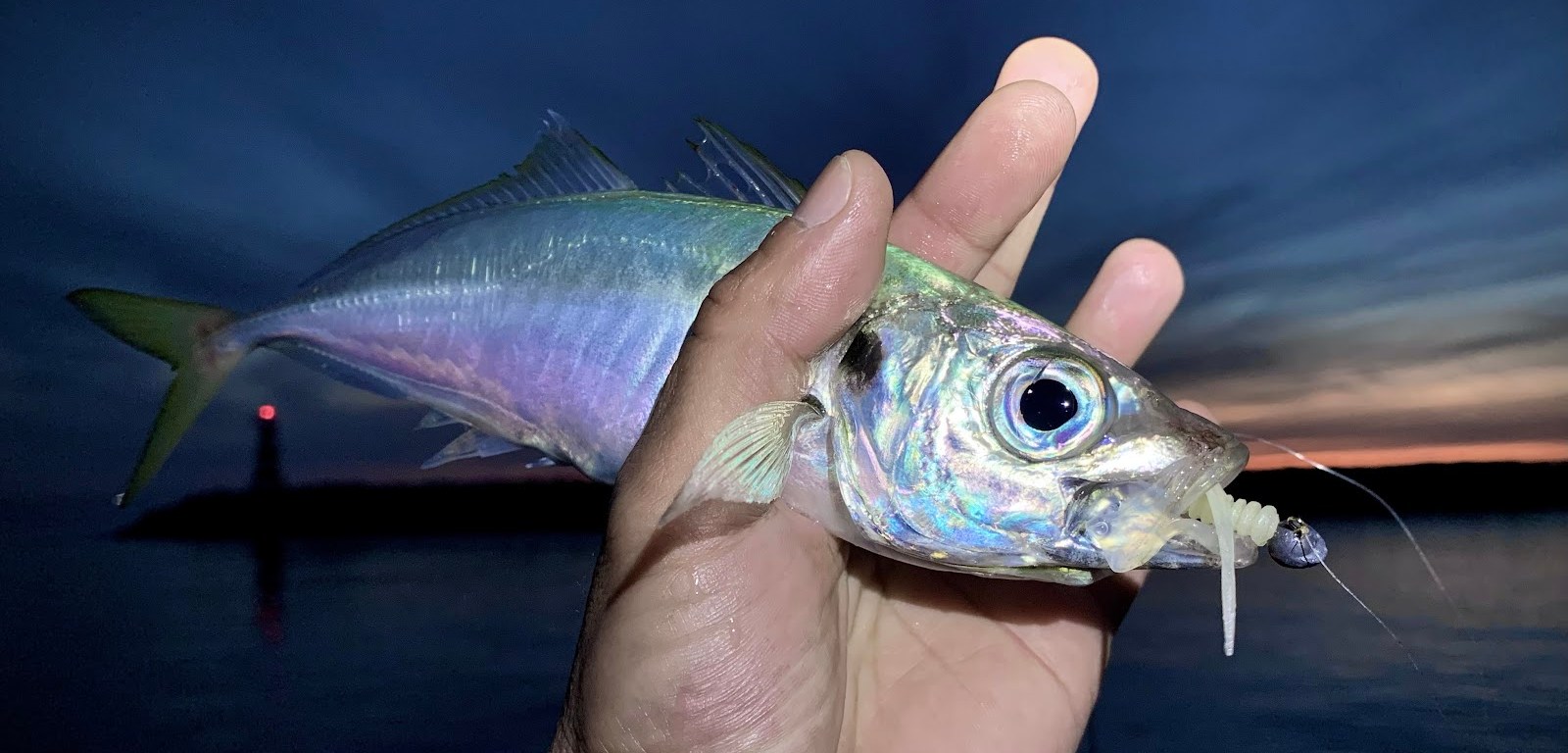
Ajing fishing was developed in Japan more than a decade ago and rapidly spread throughout Asia and more recently to Europe. The technique is used to target small pelagic species but more focused on horse mackerel aka “Aji”. The fun associated with the species opened the possibility for a specific industry, and some companies and brands produced exclusive tackle, thought and tested to catch the main target species in Japan and then elsewhere.

My journey into Ajing started with studying the Japanese way of fishing ultralight, trying to understand how and when I could target carapau (the Portuguese word for horse mackerel), what to use and why, learning about feeding and spawning patterns, and how I could adapt all that to be successful on the Portuguese Coast. The learning curve was a beautiful process and there is still a lot to learn.
The Japanese divide this game into four main elements, that will be 4:4:1:1, that in order of importance will be 40% location, 40% tackle/equipment used, 10% weather and 10% technique.

Let’s talk about location.
We can find horse mackerel almost everywhere but some of the best spots will be piers that enter the water and give us access to deeper waters. On the pier we have to choose where to cast, and according to wind, tide and current, choosing the right spot will be key. Horse mackerel feed on small marine organisms and bait fish that normally don’t have the strength to go against the water current, getting dragged and locked in by the tide, that moves with the hydrodynamics created by the structure. If we target this location, that is where Aji will be feeding.

Another key factor, the right tackle.
All the tackle is important, from the rod to the hook, everything needs to balance and will dictate how we succeed.
Ajing rod
It’s built for sensitivity and reaction, it will be extremely light in weight, made with high quality carbon, that will be very elastic and reactive at the same time. Rods can be solid or tubular tip, with fast or extra fast action. Tension sensitivity and reverberation sensitivity are how these rods should be judged. Tension sensitivity is the ability to feel the jighead weight on the rod tip, the ability to feel the resistance when the lure enters the current. Not all ultra-light rods have this “feeling”.

Reverberation sensitivity is the ability to identify the slightest inhale or bite from Aji or other small species, and the ability to identify the bottom texture due to a high reactive and elastic tip section. The high quality carbon content, high quality rings, reel seat and grip will optimise how the angler feels everything above the water line.
Ajing lines
The most popular and most used line is the polyester (known as Ester) monofilament, that was developed to fill the gaps of the existent lines on the market, that compromised the Ajing experience.
Polyester line is very thin, has a specific gravity heavier than water and it will sink, helping us to reach fish on deeper spots. It has low memory and an insignificant stretch, that will provide better casting distance, a direct contact with the lure and a real time reaction, that is especially important when targeting Aji on deeper spots, it will transmit instantly the slightest contact. This line tends to be only available in very light breaking strains.

Braid can be used and I use it when I know that bigger or stronger species are present, we don’t have a direct contact with the lure as with polyester but in some cases it might be needed, but always the thinnest possible braid I can get away with.
Reels
Built with high quality materials, lightweight and small. A progressive, precise and smooth drag, is a must fishing with extreme light poundage lines. The spools should be shallow or extra shallow and the spool size and type will determine the line to use, they should match to aid casting and line lay.
The jig heads
There’s lots of ultra-light jig heads on the market but not all are suitable to use in the Ajing game. The head shape shouldn’t create fast or erratic movements, on the contrary, it should create some resistance in the water that will help locating/feeling the jig head, optimising a steady and natural lure presentation, key to target horse mackerel. The hook should be small, strong, thin and sharp to penetrate the hard palate bones of the bigger specimens, the typical Ajing hook will have the tip pointing upwards, to facilitate a deeper hookup, avoiding the soft parts of the mouth.

Lures – Soft plastic worms
Choosing the right plastic is essential to catch Aji. We should consider the size of prey that the horse mackerel feeds on in each time of year, it could be small bait fish or plankton. Time of day is important too, if fishing at night, I consider if there’s any light, natural or artificial, and choose the right soft plastic worm according with the present situation. Glowing lures are attractive to Aji.

Aji feed voraciously when gaining body fat but don’t feed before or during spawning periods, therefore we must adapt the worm size/shape/profile and colour patterns to the present prey in order to get some bites. So having a good variety of lures is important.

About weather and technique
Clear water and calm conditions (day or night, but the night game will be more productive due to the increase of activity) will be perfect to target them, and the 10% of technique can really make a difference when all the other factors are considered.

Fishing aspects/conclusion
When starting a session, it’s a good choice to cast and use the sinking counting method. This method consists of casting and letting the lure sink for 5 seconds and try to maintain the lure on that same depth during the retrieve, maintaining the fall as horizontal as possible. If we don’t get a bite, cast and let it sink for 10 seconds, and again try to maintain the lure at that same depth. We will continue this until the count of 15,20 or more until we locate the fish depth. Once located, for example at the count of 20, the next cast we will have the same drop time and we will have another bite and another …
Aji will eventually move to feed on another spot or depth, and we will restart the process again until locating them. Remember if you change weight or worm profile/shape/size the counting system will have to be adapted, the lure will fall on a different sinking ratio.

A key factor is that Horse Mackerel need to effectively see the lure, and a slow falling worm will be longer in range, it could be seen for a longer period and that will induce the bite, that’s the reason why we should cast the lightest weight as possible to stay in the bite.

Through this text I’ve shared with you some of the things that should be considered when targeting this beautiful and finicky species and that’s why this game is so challenging and so addictive, hopefully I have other opportunities in the future to write about more details.

In my opinion it’s one of the lightest techniques we can try in saltwater, a game of strong emotions and thin lines, and all the knowledge can be applied to other fishing techniques, making all of us better anglers. Hopefully it can inspire you to try it, wherever you are in the world.

 The Big Lerf
Great article about Ajing. The details and informations are exactly the same as I have experience it on hand in my very sessions. Iam from The Philippines and have been doing Ajing for quite sometime, and definately this article says a lot. I hope you guys make this kind of article more often, particularly on Ajing Game.
Hope for the best for you all.
LikeLike