
By Ben Bassett
What if I was to tell you that the single most feared fish in UK waters held an even darker, more grotesque secret? That the species responsible for more newspaper headlines, injuries and fear mongering was actually far scarier than you had once thought? This is a sci-fi like tale of vicious parasites in a Cornish town, yet almost no one knows about them.
The headline grabbing fish is of course the lesser weever. A small, rather unfortunate looking creature that injures scores of bare footed holiday makers every year around the UK coast, with most injuries occurring in the busy waters of Devon and Cornwall. The weever gets its name from the old French word ‘wivre’, meaning serpent, and the latin name Echiichthys vipera continues the theme of ‘viper’, all are names that make cleat the link to its venomous sting being like the bite of a snake.

Lesser weever, and their larger cousin the great weever, have venomous glands at the base of their dorsal and gill spines. These spines are what deliver a shot of venom to any unfortunate foot or hand that touches them. Most often this happens when unwitting humans walk barefoot through soft sand in the warmer months. Thankfully the venom’s effect can be reduced by placing the injured area in water as hot as you can possibly stand, as heat breaks down the venom. They are often labelled as poisonous, but in fact both species are known to be quite fine eating. You would have to eat a lot of lesser weever to make a meal, as they are a small fish, often no more than 15 cm.
They are a species mostly associated with summer, but in southern waters they are inshore and active throughout the year. It just happens to be that they come into the shallowest water when we all decide to do the same. Despite being a hard fish to love, I actually really enjoy targeting this unusual species, especially using small metals worked close to the sand. I was doing just that when I had my first ever meeting with the ‘tongue snatcher’.
It was a beautiful late April Saturday, fishing a sandy Cornish estuary with Maurice Mitchinton. The day had been typically spring-like, bright and sunny, with very few bites. We decided to target the shallow waters at the mouth of the river, casting our small metal jigs to the various sand bars. I knew there was a large population of weevers there, and if any were large enough, they would greedily attack my 3g Xesta Afterburner, as I flicked it across the sand slowly.

Sure enough it didn’t take long for the bites to arrive. Weevers can hit a metal with surprising force, and it is always funny when you hook up and the culprit is barely bigger than the lure itself. That exact scenario had just happened and I had my first weever of the year on the weed, ready to be unhooked. I use forceps when handling weevers and I gripped the treble hook ready to angle the hook away from the fish’s upturned mouth. It was in this moment when I realised something was very wrong.

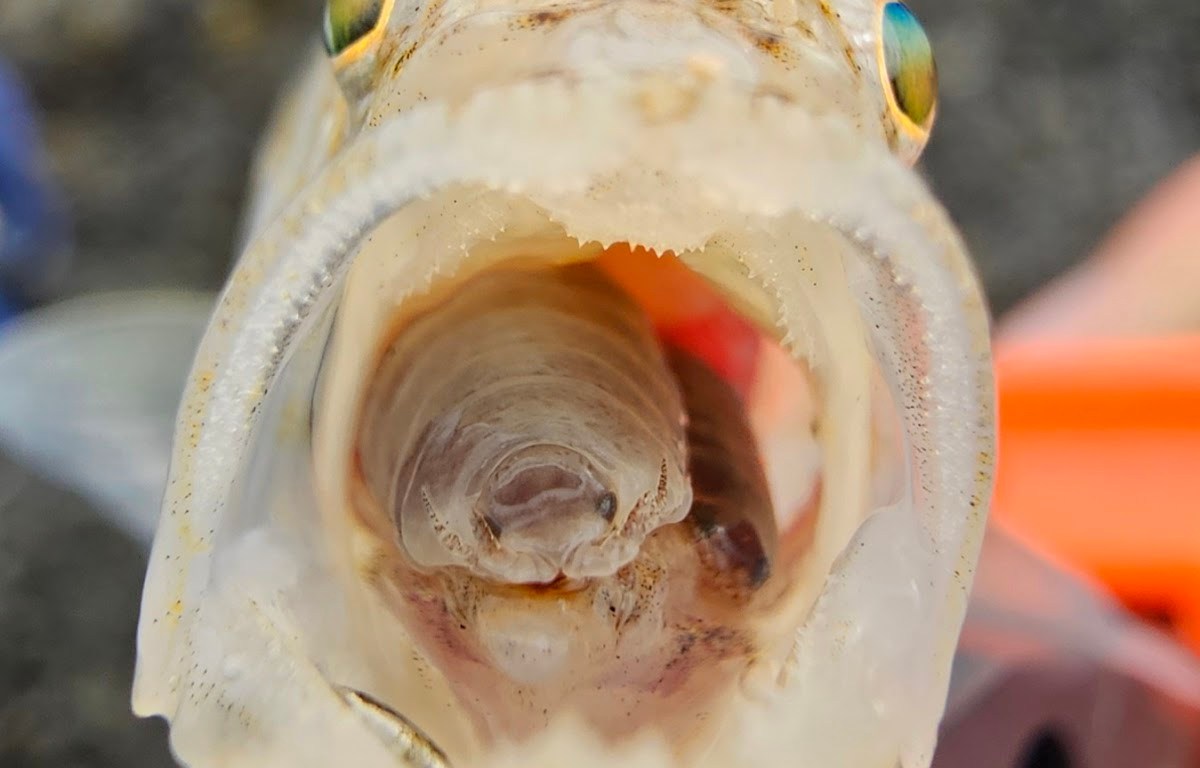
Poking out of the weever’s mouth, exactly where its tongue should be was what I can only describe as an angry looking woodlouse. I knew exactly what it was, but could barely believe my eyes, having read about this bizarre and rather grotesque parasite before. I debated removing the beast, but I had also read that once embedded, it can actually be more damaging for the fish to remove the parasite than for it to live with it. So I got some pictures, noticing there was actually two parasites in this poor fish’s mouth, a large female and smaller male, tucked in behind. Then the unfortunate creature(s) went back to the sandy river.

The exact parasite was Ceratothoa steindachneri, a type of parasitic isopod, distantly related to woodlice. They are very closely related to the parasitic isopods you find on the skin of fish, often attaching themselves next to the head or by the tail. I have personally caught corkwing and pollack afflicted with these, as well as comber in the Mediterranean. The obvious difference with steindachneri is that it attaches to the fish’s tongue, consuming and replacing it. It was first discovered in the UK in lesser weever fish collected from Whitsand Bay in Cornwall in 1996. Since then it has been found in weevers across the south of the country. It is speculated that global warming may be playing a part in this, as parasitic isopods are far more common in warmer waters.
Regardless of the species, you most often find a larger female attached with a small male tucked in close just behind. All of these species are equipped with incredibly sharp, gripping legs. Because of this, regardless of how gentle you are, you almost always injure the fish when you remove the parasite. My hope is always that the injury is less serious than having a large bug chewing on your skin and sucking your blood.
That day I caught two more weever with the same tongue biting parasite. All went back still with the critter attached. I was struck with a mix of curious awe and skin crawling disgust. As humans it’s hard to contemplate living with such a huge parasite in an area like the mouth. It just goes to show how tough fish are and how vicious nature as a whole can be.

So next time you catch a lesser weever, check the mouth if you can, perhaps yours too will not be alone…


