

By Ben Bassett & Rich Salter
Whether you are taking part in competitions or posting on social media, great photos have never been more important for the modern lure angler. Luckily it has never been easier to take fantastic photos, simply by a tap on our screens. In this article we will go through the basics on how to improve your shots, without the need for bulky DSLR cameras.

Firstly, we best address the elephant in the room, we have to admit that some of the photos entered into our competitions are a bit rubbish. Whether the photo is taken from too far away or in low light, or is simply blurry, we have seen them all. Hopefully with this simple guide, we will see a higher percentage of great photos posted on our social media pages.
This guide is to improve your phone photography so let’s delve a bit into that. We are talking about your run of the mill smartphone here. Be it iPhone, Samsung, Oppo or others, most smartphones these days are running with great photo software straight out of the box. If you are really passionate about phone photography, it is best to look at the specifications before you buy. The flagship phones are guaranteed to have exceptional cameras, but even in the lower to mid price ranges, the technology is there.
We recommend you practice with your camera, choose a subject – perhaps a lure, and snap away in different light conditions. This is achieved simply enough by closing the curtains and turning the light on and off. Most cameras will prefer natural light, which is clearly plentiful when out fishing in the day, but low light and nightime photos are the challenge, especially with a wriggling fish as the subject. So practice is key. It is also worth using your headtorch, work out how much light is too much, often turning it to a lower power setting will lower the risk of glare.

Focus is hugely important too, phone cameras have excellent quick focus but can often pick out the wrong areas in the shot. Often the camera will pick out the background instead of the fish. This can be remedied by tapping on your subject on the screen, this will tell the phone where to focus. Most phones will have some form of macro mode too, test this out by getting really close to your subject, finding out how close you can get while still maintaining an excellent image. You may be surprised.
Lighting is a really important aspect of fish photography too. Even during daylight, it can be tricky to bring the best out of a fish in certain conditions. In bright sunshine, the colour and detail of a fish can be lost as your camera struggles to deal with the glare or excessive light, changing angle or using your own shadow can really help with this. A shot with the sun behind your fish can make for a great silhouette shot, but isn’t great when it comes to species identification or showing your fish in all it’s glory, so it pays to have in mind what sort of shot you are looking for.

When it comes to Lerfing photos, there are two important types. There is the identification photo, crucial in species hunt competitions. The other is the trophy shot, used to share on social media or simply keep for yourself to look back on. It seems strange to talk about ‘trophy’ fish when some of our subjects are truly tiny, but even the tiniest of species can have incredibly detailed markings and are worthy of our attention.
The Identification Photo
Coming off the back of The 22/23 Winter League, we have seen a lot of these. Some are fantastic, some are not. Here we will go through our tips to improve your ID photos, and the majority is common sense.

For most clear identification you really need a close up clear shot of the head, the full fish with fins on display and perhaps an underside photo, crucial for some species such as short spined sea scorpions. It is here where your practice with your camera’s macro mode comes into play. The key is to get close, you can’t identify a fish clearly when it is on the floor and you are standing up. Try different angles, one of our favourites is with the camera at a 45 degree angle from the mouth of the fish, looking down the head to the rest of the body. Not only is a good angle to work out species, it looks cool too.
When it comes to especially tricky species, fin position, fin ray counts and lateral scale counts are the only way to tell. So clearly, taking good photos of these areas is important. By far the best way to do this for the mini species is to use a viewing tank, preferably one that isn’t scratched or hazy, or curved so it warps the image. In a viewing tank full of fresh water from where you caught the fish, your subject will be relatively comfortable while you take the photos you need. They will also put all of their fins on display. Take lots of photos from different angles, nice and close to your subject, and ensure they are well lit, either by sunlight or from a torch.
The Trophy Shot
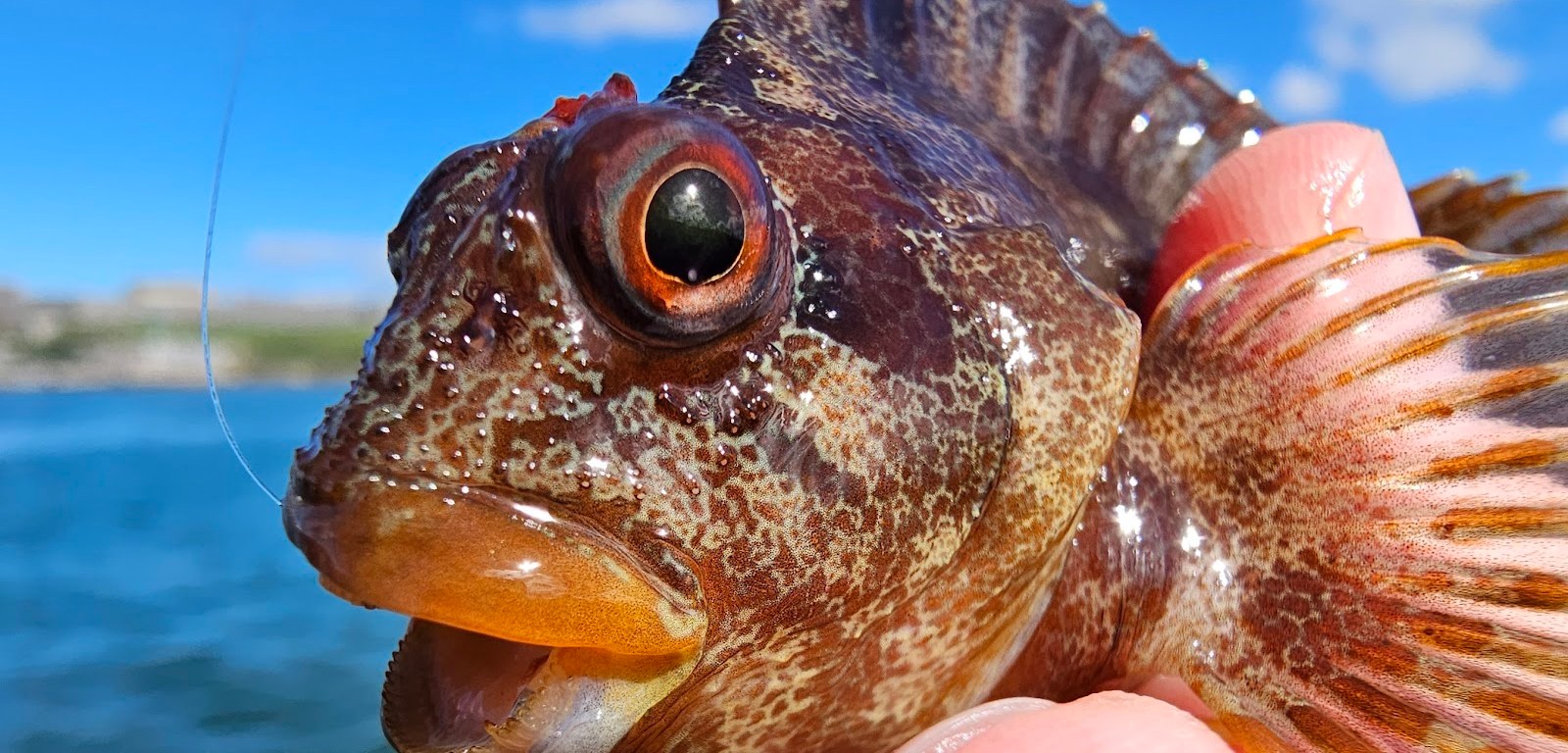
Ben’s personal favourite photo to take. This is the photo to really show off the fish, either in the angler’s hands or on a suitable safe surface. With a great trophy photo, you will both wow your fellow anglers and enjoy looking back on it for years to come. A great example of this is the long spined sea scorpion that made the front cover of the very first Big Lerf Magazine. Caught by Rich, it was a real specimen sized fish, but a photo taken from far away wouldn’t do the fish justice, so Ben took it from the fish’s level, ensuring it filled the photo, with Rich in shadow just behind.

With smaller species, it is easy to lose their detail with a photo that is taken at the wrong angle or too far away. Getting in close, using the magnifying effect that phone cameras have, really shows them off. Think of how anglers are often ridiculed for their ‘telescopic arms’ when holding out pike or perch, well this is actively encouraged with mini species. Get them close to the camera with the angler in the background and you will have a trophy shot even with a smaller fish.
For other species, think about what you want to show off. For flounder, the coolest looking part of the fish is the head, so we recommend photographing with the focus on the front of the fish. It is a tactic that works for most species, as that is the business end that we are all interested in. Whether that’s the rainbow swirls on a corkwing’s cheeks or the armour plating of a grey gurnard. Alternatively it could be the subtle patterning on a black goby’s dorsal fins or the green and blue tiger print of the tub gurnard’s wing like pectoral fins.
Post-production
There is a simple way to improve even average photos – edit them. Your phone comes out of the box with at worst a basic photo editor. Use this on your photos. One of the easiest and most important tricks is the use of Crop. Cropping your photo, the act of trimming off the edges of your photo to show the subject properly is crucial. With a simple pinch and crop on your phone you can remove the dead space, ensuring the fish dominates the image. A good motto is, unless the background is enhancing the photo, get rid.
Using apps like Lightroom can help the colours pop by tweaking the vibrance and contrast.
Other apps like Adobe Lightroom and Photoshop have free versions available and are excellent tools. Lightroom especially as its ‘Auto’ mode is very effective at improving colour balance and enhancing detail. There are plenty of others and all top brands will have their own in house apps that will work. Even using Instagram or Facebook as editors will work, but be aware that any image uploaded onto these sites loses quality, the same with those sent via Messenger or WhatsApp. The best way to send photos is via WeTransfer.com and email.
So in summary, get close to your subject, tap the screen to focus on it, take plenty of photos and try different angles to get the best shot. Then once you have taken your photos, tweak them with your phone editor. If you are sending them to, let’s say your favourite LRF magazine, then send them via WeTransfer or email. We can’t wait to see you put this into practice.

Corkwing wrasse make for excellent subjects.


Viewing tanks are great for taking clear photos of the smaller species, such as this montagu’s blenny
 The Big Lerf