

By Ben Bassett
The Japanese love fish, both catching and eating them. They are also a country of specification, honing their craft and finding the perfect way to complete their chosen task. Combining this desire to fine tune with an island population, it’s not surprising that Japan also birthed saltwater light game lure fishing, which then branched out into the myriad of forms that it is today. One of those finesse lure fishing applications is focused on the Aji (horse mackerel), and I intended to honour the Japanese technique of Ajing at the end of the August 2022 heatwave.

The mackerel had arrived in huge numbers and Plymouth Sound was once more alive with fish. But lots of mackerel means lots of people trying to catch them, this leads to many of my favourite marks around the city becoming unfishable. The seafront quickly becomes a warzone as huge sets of feathers and heavy lead weights are repeatedly cast by those who don’t get quite enough practice. So as an angler who prefers to fish without the risk of having a six ounce lead embedded in their skull, I was forced to find more remote marks or fish at more unsociable times.
Four in the morning in a very unsociable time, which meant I had the seafront to myself. There was an uncanny feeling in the air, the hustle and bustle of the day still hours away. The sea wall felt strange under the streetlights, as if haunted by the many fishermen who had come before and of those yet to come. Soon the place would return to the sound of whipping rods and crashing leads, but at that moment, all was quiet and still, except the sound of the incoming tide, pushing in steadily in the darkness.

My headtorch flickered into life and illuminated the cobbles by my feet, sea slaters scattered in panic. It was as if I had crashed a party of seafaring woodlice, my presence causing these pirates of the isopod world to scuttle away into the dark. In the torchlight I set up my weapon of choice for this early morning raid. The rod would be the legendary Majorcraft Aji-Do, rated only to cast up to 3 grams, solid tipped and fast actioned, perfect for recreating Ajing on British shores. On my tiny 500 sized Shimano Vanford reel, I had a spool of Majocraft Ester line, rated to a scarily delicate 1.5lbs breaking strain. The approach rewarded finesse, and in the still heat of ‘The Ocean City’, finesse was exactly what I was bringing.

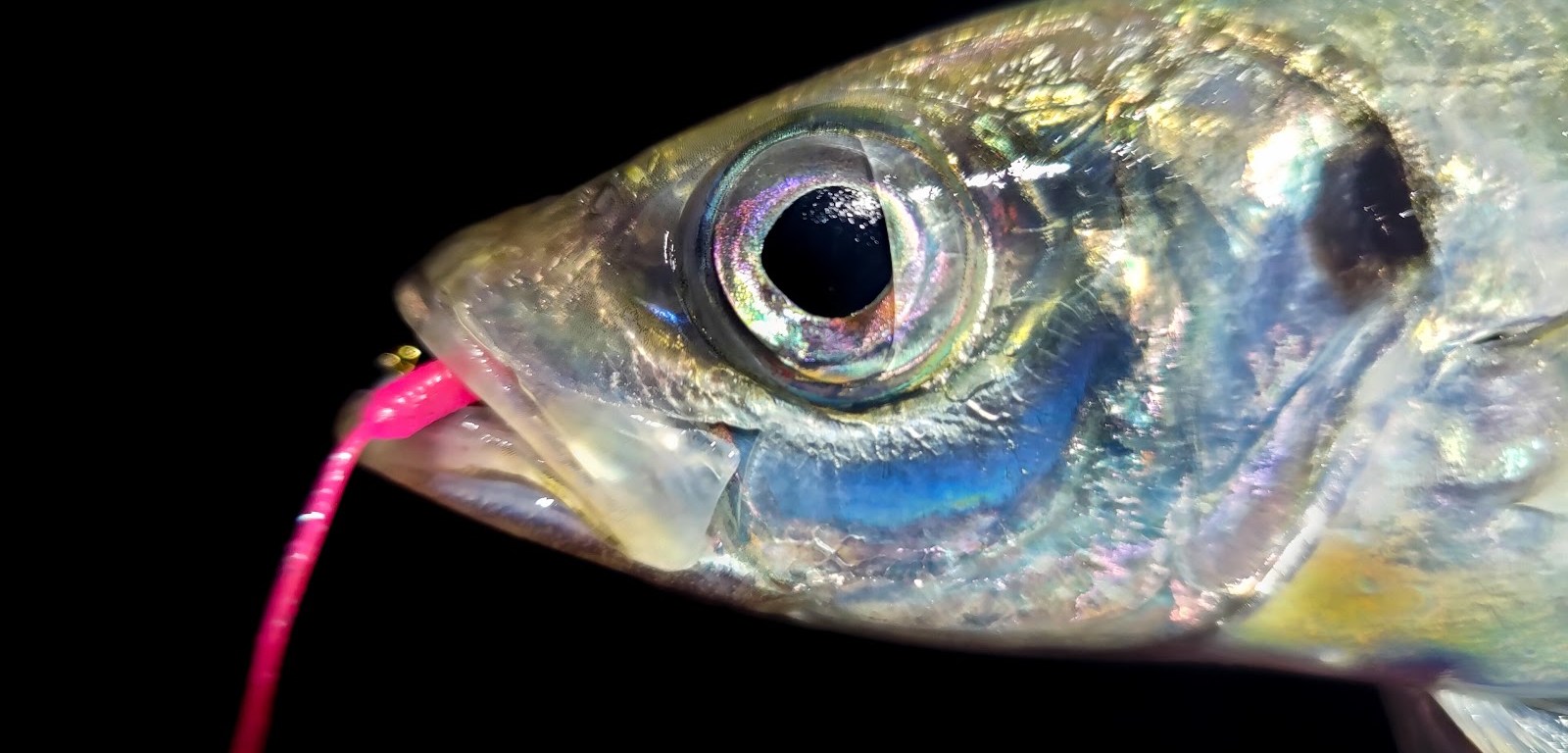
Ajing comes with its own set of lures and jigheads, a product of the Japanese obsession with perfecting everything they pursue. The hook on the jighead bends out as if you have just pulled out of a snag, I admit to English eyes it looks wrong. This is especially pronounced on the Thirty Four Zerogra heads, where the hook is bent at more than a 45 degree angle up, ready to pierce the tough bony roof of a scad’s mouth. These unusual jigheads are coated in a floating resin that helps to slow the fall of the lure, keeping it where the fish is waiting to attack. I paired this funky looking head with a pink glowing Majorcraft Paraworm Curltail, essentially a long thin lure with a tiny curly tail for movement.

All around me I could hear the splashes of feeding fish, a literal dinner bell being rung and I excitedly prepared myself to make the first cast into the darkness. I normally focus on the areas lit up by streetlights, but the fish were clearly more active in the open river. This would have to be done by feel rather than sight. I flicked the ultralight lure out into the gloom, Ester line leaping from the spool of the miniature reel. With the smallest of plops, the lure began its descent to the feeding fish.
The trick with this technique is to count the lure down and then slowly retrieve when you find the level you wish to fish at. The tide was pretty considerable so I had to adjust my retrieve by casting up-tide and feeling the lure back in the current, keeping the line taut so I could feel the bites. After a few exploratory casts I found the crease in the current I was looking for and twitched the lure into life. After a few turns of the reel the rod tip registered the resistance I was looking for and I struck.
A fight in the darkness began. Even though I knew this had to be a scad, there is always an enticing mystery when your senses are heightened in the low light. The fish fought deep and hard, using the current to its advantage. On such a light line I couldn’t bully it in, but to me that was a benefit, as I could savour the fight instead of hauling this fish in on heavy gear. I flicked on the red lamp on my Fenix headtorch, in the hope of not spooking any further fish following the fight. The iridescent flanks of the scad reflected the red glow and the scene briefly resembled a cinematic alien abduction, a moment of spinning otherworldly light.
Composing myself I lifted the fish from the river, holding it with a pair of fish grips. The grips essentially a pair of toothed tongs that I occasionally use on species such as mackerel and scad to avoid scale loss. They are not my favourite way of handling fish but for a few photos gave me an alternative to a palm or lip grip, especially so I could appreciate the predatory head of the scad. If grips don’t sit well with you, a good alternative is a pair of thin gloves, which (especially when wet) don’t appear to remove quite as many scales as bare skin from fish such as mackerel and herring, and limit the grazes you get from the spiny lateral line of the scad.
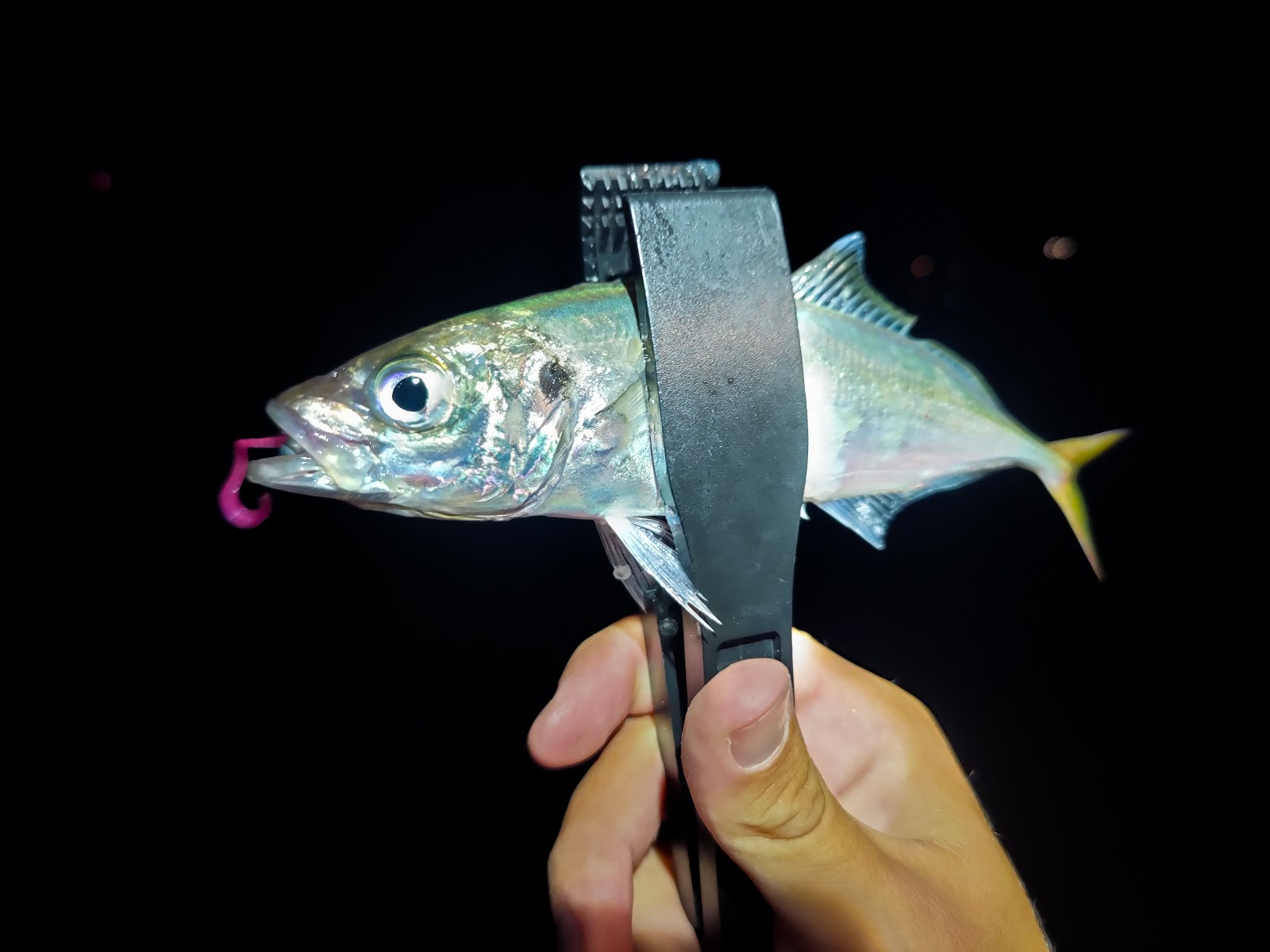
After a few photos, the scad was returned to the inky black river and disappeared in an instant. The tide continued to build around me, the steady lunar push of saltwater making its way up the estuary to my right. I was brimming with confidence, and decided to switch to a new lure, one that didn’t glow in the dark. It was a pin tail lure from C.A.N Fishing Lures, pink, semi transparent and loaded with glitter particles. As I pulled the soft plastic lure around the bend of the Aji hook, I was amazed at the balmy temperature in the early hours. I could easily have been abroad, but I made another cast into my local waters and repeated the process like before.

I would have hated to be any kind of prey fish that morning, as the scad were clearly in no mood to let any potential food escape – I was in again almost immediately. When the fishing is so good, I tend to lose myself in the cycle of cast, bite, pause, strike, play, unhook, release and repeat. The simple joy of easy fishing and balanced tackle, feeling every beat of the tail and engulfing of the lure. In the early morning hours, as the distant sun began to turn the sky pink in the east, I stood alone with a smile on my face, catching fish after fish. It was pure LRF enjoyment, the ultimate antidote to the incoming storm of heavy rods and giant hooks, which was surely only hours away.

I fished on until the sun finally peeked above the horizon, all the while considering how UK LRF has embraced the art of Ajing within its many forms, and Ajing has given back with incredible rods, lines, lures and techniques. To Aji is to improve your angling, dialling your senses into the fine plucks of biting fish, and learning to work balanced tackle even in difficult conditions. I enjoyed that early morning raid more than I could ever appreciate pulling the same fish in on strings of feathers, and walked away a happy angler in the morning sunlight.

 The Big Lerf